Back in 1991, Steven Spielberg directed a film titled Hook starring Robin Williams, Julia Roberts, Maggie Smith, and the incomparable Dustin Hoffman as Captain Jas. Hook. John Williams produced the soundtrack (to which I am currently listening). Hook provides an intriguing twist on an extremely original tale, and I submit that the title is purposefully misleading. The first line of J.M. Barrie's book, Peter Pan, states "All children, except one, grow up." Hook begs the question, "What if that one grew up?" Maintaining indefatigable continuity with the book, Peter (Robin Williams) comes to what we might call Reality and begins to grow old. In the way that Neverland makes one forget about Reality, Reality makes one forget about Neverland. Thus, there is a tension between the two.
The movie opens with Peter's complete consummation by Reality. He appears as a successful lawyer who orchestrates business deals involving vasts amounts of money. Nevertheless, his drive for success marginalizes his family. On a family trip to England in order to visit "Grandma Wendy" (Maggie Smith) and after a mysterious Capt. Jas. Hook breaks into Wendy's home to kidnap Peter's two children, Maggie and Jack, Wendy reveals to Peter and to us who his true identity is, the Peter Pan. Of course, he finds this completely preposterous, but when Tinker Bell (Julia Roberts) appears and drags him to Neverland, he must face the reality of his forgotten childhood.
In Neverland, Captain James Hook is furious. Made clear by the film, Hook has been stewing for years over the absence of his "great and worthy opponent" Peter Pan. Now, Hook, with Peter's kidnapped children in tow, will finally be able to launch his full out war on Peter and his lost boys. Quite naturally, Peter Banning, whom Peter Pan has grown up to be, enters Neverland completely ignorant of his lost identity. Confused by such a goofy world that is Neverland with its pirates, mermaids, and renegade, pirate-killing orphans, Peter halfheartedly attempts self-discovery for the sake of saving his children. In the meanwhile, Hook turns Peter's son against him, and in normal Neverland fashion, Jack forgets about home. As Jack forgets, Peter remembers; except, he remembers with a twist. He remembers who he is, not because he recalls the features of Neverland, he remembers Neverland and his identity as Peter Pan because he recalls the joy he felt when he became a father. The elation and new life of childhood reignites Peter's ability to fly and battle the incarnate evil, Captain Hook.
Before I finish telling the story, let me turn to the obvious quite obvious message behind this story. At 2 hours and 20 minutes, Hook can hardly be considered a pure kid's movie (even though I watched it countless times as a child). Instead, Hook is a film made for parents couched in a kid's film disguise. As adults, what once carried the excitement of newness for us as kids gives way to the mundane product of experience and recognizable repetition. Peter who once was capable of thinking imaginatively of newness, becomes bound by the restraint of what he knows. This is made ever so clear when he tries to save his children by writing Hook a check or when he cannot eat simply because he cannot imagine food. Hook, therefore, romanticizes childhood in an exciting, entertaining way. At the same time, Captain Hook reminds us that childhood does not come without difficulties.
These struggles we face as children loomed large to us then. The film humorously puts it to us in Hook and Peter's discourse as they fight their final battle:
Peter: "I remember you being a lot bigger."
Hook: "To a 10-year-old, I'm huge."
Now, Peter has returned to fight off his old foe once and for all. Why? No longer can he avoid it. See, in Reality, Peter became a pirate with his corporate takeovers and hold-no-prisoners economics. What happened? He oppressed his family and his kids. As a result, his son became a pirate, merciless and tyrannical. The commentary here is explicit. As adults, we must face and fight our childhood terrors. We avoid them because we remember them being huge, but if we stave off the fight, we will become what oppressed us. Consequently, the next generation will suffer from our Hooks. Hence, the cycle is created.
Briefly, I would like to implicate the Hebrew Bible. Clearly, the authors and compilers of Genesis recognized and theologized this cycle. We can see it as the faithfulness of Abraham passes from generation to generation until Joseph. Joseph becomes imperial, and he delivers his own people into the hands of the oppressors. Notice the oddity of Jacob's blessing upon Joseph's two sons in Genesis 48. Why does Jacob not reach out his hands and bless Joseph in the way Jacob's father did to him? Jacob attempts to pass on the blessing to those not yet tainted by the oppressive empire. Furthermore, this whole narrative is alluded to in the second word of the Decalogue in Exodus 20.4-6:
"You shall not make for yourself an idol, whether in the form of anything that is in heaven above, or that is on the earth beneath, or that is in the water under the earth. You shall not bow down to them or worship them; for I YHWH your G-d am a jealous G-d, punishing children for the iniquity of parents, to the third and fourth generation of those who reject me, but showing steadfast love to the thousandth generation of those who love me and keep my commandments."
What we see in Hook is a father's idolization of that which is not the life-giving, creative G-d, and as a result, his children pay for it. He then confronts that which oppressed him and a child (his idol), and defeated it. It is to how he defeated it that I now turn.
Upon Peter's self-realization in the film, the pace quickens. He forgets he is an adult, and he becomes consumed by the desires of being a young boy. Immediately, the film clarifies. Peter cannot save his kids if he believes he is a child. The narrative presents Peter with a dilemma: how does one maintain the innocence of youth and the strength that one gains through the long process of growing up to fight the very demons of that youth? Or put more metaphorically, how do we stay as big as Captain Hook yet as free as the lost boys? The film gives us three answers: creativity, community, and evil's inoperable sustainability.
In the film, the Lost Boys are a precarious group of orphans who live under the constant threat of violence from the oppressive adult pirates. Rendered unable to go where they wish or live as they please, the Lost Boys subvert the authoritarian rule of Hook using only their imagination. Even eating requires them to utilize their imaginative power. As a result, beneath the oppressive thumb of Hook and his cronies, the Lost Boys thrive. Alas, when an adult who finally takes their side leads them in a rebellion against the oppressors, these disenfranchised orphans do not fight in shear numbers. Instead, they fight with creative tools such as tomato-flinging slingshots, a four-direction paint gun, marbles, mirrors, and an egg-gun. The plausibility of these weapons being deployed by children actually working against a contingent of armed, full-grown men is inconsequential and irrelevant. The movie is disinterested in practicality. Rather, it implies the creative efforts of the oppressed render the confidence of the powerful as a weakness. Creativity overcomes physical power.
As Peter fights Captain Hook, he receives the aid of the Lost Boys. Hook, you see, in a wonderful metaphor, fears time more than any other thing. We see this in Peter's own life before he made it to Neverland. He frantically attempts to work and support his son by attending his baseball game which Peter tragically misses. He fights against time. Captain Hook does likewise. He finds sport in destroying clocks that tick; thus, reassuring himself that in fact time does not exist. The film clearly responds to this with the affirmation of time. When we embrace time as the conduit through which we live, we learn to actually enjoy life, the time we are given, and the people we spend it with. There is no greater example to this than when Peter fights Hook in the final battle between good and evil. As their ace in the hole, the Lost Boys pull out ticking clocks. The over-stimulation of Hook's greatest fear paralyzes him, and the theme is driven home as he stands facing Peter in a circle of Lost Boys without any friends to help. Peter understands the strength in his friends and family. Hook, bent on vengeance, cannot allow the aid of his minimal friendships lest his revenge feel anything less than self-earned. Only through the help of others can we in fact defeat what haunts us most.
The description of that scene leads to my final point. Evil cannot sustain itself. The moral logic of oppression leads the oppressor into lonely, self-destruction. In a gut-wrenching, tear-jerking way, we see this in Rufio. Rufio is the boy who took control of the Lost Boys in Peter Pan's absence. Dressed like a punk rocker, Rufio acquiesces to Hook's logic. Hook hauntingly seduces Rufio into a blade-on-blade battle by slowly chanting his name right after Peter forbid Rufio from fighting the old man. Rufio is shown as a good swordsman, but clearly, he is no match for the superb Captain Hook. Rufio gives in to the promise of power that can be achieved through the death of Hook. Effectively, Rufio tries to beat Hook at his own game. Little does Rufio know, one cannot overcome evil with the tools of evil. Rufio only realizes this after Hook slays him. Dying in Peter's arms, Rufio (and I have to hold back tears thinking about it) says to Peter in a powerful last breath, "You know what I wish. I wish I had a dad...like you." The film drives the point home when the young Jack takes off his pirate's hat, addresses Peter as "Dad", and tells Peter, who still holds the dying Rufio in his arms, he wants to go home. Creative, communal love creates home; evil tempts and destroys. It cannot persist then, for it destroys that which it lures.
We see evil's demise at the conclusion of Peter's final (dare we say, loving) battle with his childhood foe. The sword fight builds in the very typical way that all sword battles typically do. Meanwhile, we wait for the very typical end. We wait for Peter to be given the opportunity to kill Hook, yet in his goodness refuse. Very surely, this time comes (twice actually), but Peter is rescued by the sweet innocence of his daughter. Naturally, the next action is Hook trying to kill Peter even though Peter mercifully spared his life. What we would quite expect is Peter to kill Hook, but this never happens. Instead, a twist comes. Peter, with the aid of Tinker Bell, thrusts the Captain's hook into the belly of the crocodile who consumed Hook's hand after Peter cut it off so many years ago. While this could simply be seen as an homage to the book, the action suggests otherwise. We see Hook stumble and stand with complete balance. He seems completely able to avoid the crocodile who has awoken from the dead. But he doesn't. Why? Perhaps it is because Hook longs for death. Evil cannot endure forever; it cannot bear the weight of oppressing eternally. Furthermore, evil is not indestructible. Even it has fears such as time. In the end, Hook's fear of the crocodile, his exhaustion of being vengeful, and his lost battle against time bring about his demise. Peter's refusal to kill shows his victory, for he knows that evil will kill itself.
In the end, we see the beauty of creativity, innocence, and community. These are not weaknesses. They are strength. Unless we learn to embrace them as strength, we will continue to let Captain Hook and his violent, oppressive logic dominate every generation. However, if we learn how to embrace the time we are given to live and if we enjoy those we are given to live it with, we may well learn to defeat Hook once and for all. That is exactly what we see in Jesus' life and most clearly in Jesus' death and resurrection. We cannot beat the oppressors on their own terms. We can only reveal the natural demise of sin which is death. We reveal this by showing the natural way of G-d which is life, and as Peter says at the very end of the film, "To live... to live would be an awfully big adventure."
Agnus Dei
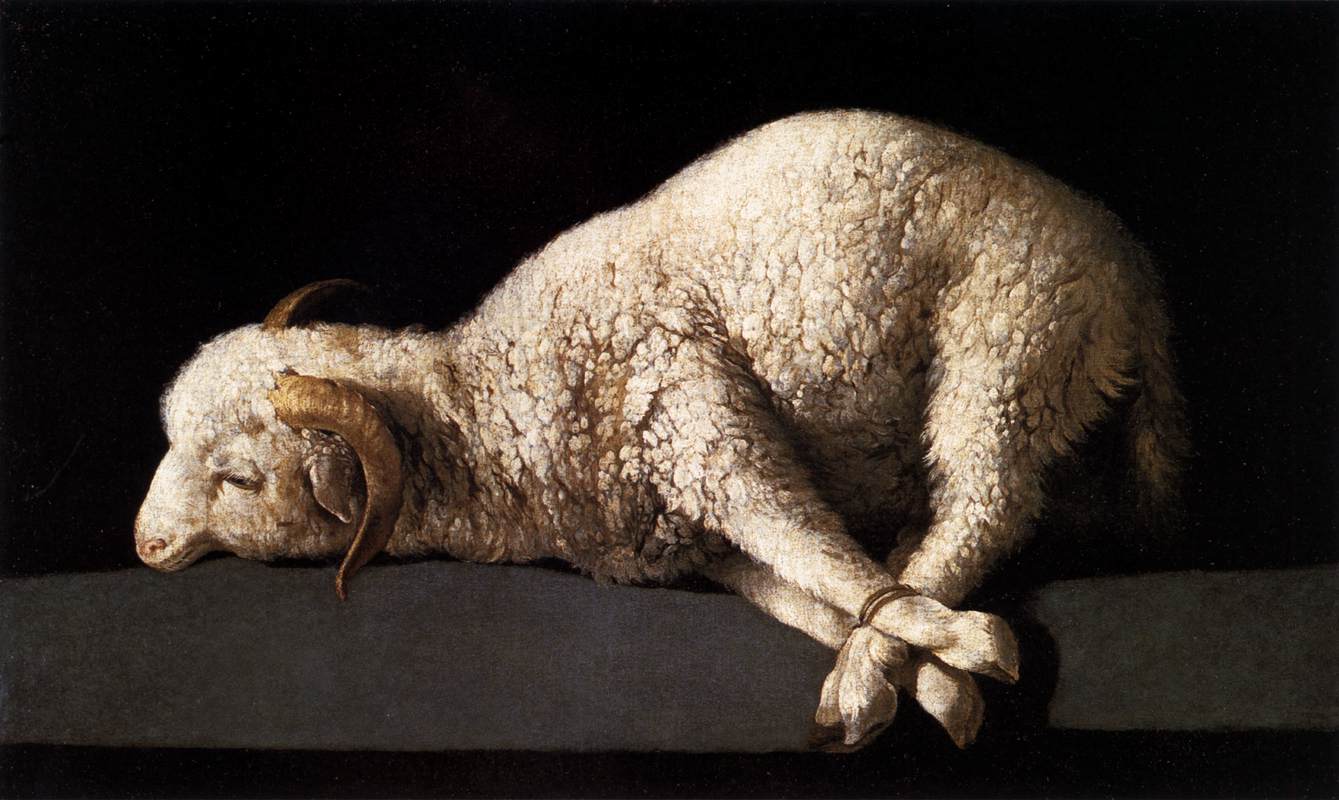
How G-d rules the world!
Showing posts with label Jesus. Show all posts
Showing posts with label Jesus. Show all posts
24 September 2010


15 August 2010
07 May 2010
Why Christian Faith and Patriotism/Nationalism Are Incompatible
One day, my father said to me, "In an age in which we possess pictures of the world from space, we know that actual national borders do not exist. We decided where they are. So I do not see how one group of people has the right to tell another group of people where they can and cannot live based on borders that are imaginary." I think about this a lot. His insight implicated to me the fundamentals of culture and the nation-state. By reflecting on my father's statement, I hope to show that patriotism cannot coexist with resolute Christian faith.
Nation-states are comprised of people. They rely on social contracts. In these contracts, people decide which cultural groups will make up the nation-state. After the borders of the nation-state are drawn, people from within those borders erect a system of rules under which everyone within those borders must abide by. If these rules are not followed, the people who created the system, or their inheritors, will coerce the people to abide by them. This coercion may be a police force or an army. Of course, this means there must be some level of agreement on what must be punished and what must be accepted. People then decide whether on what is allowed. Whatever is decided makes up the code for identifying the nation-state. A nation-state is the laws enforced upon people within certain (imaginary) boundaries.
Who creates these boundaries? A person of meager living with few possessions and little influence will have both little need of creating boundaries and little power to do so. Only those who have much will require the safety net of a nation-state and the security it promises. Not only that, those with substantial means are the only ones viable to provide the resources necessary to build a system of government. Thus, all governments develop by the elite and for the elite. Patriotism becomes the way into maintaining the wealthy and their power.
By convincing people to believe that the legal code within the imaginary boundaries that encapsulate their living space is the most supreme and just legal code, the wealthy elite who created the nation-state grasp the loyalty of all those within the imaginary borders. Hence, those who have little need of the nation-state become its most loyal subjects. Why? Because if they resist the new order, if they say no to the financially powerful, they will be coerced into complicity, for the ones at the top of the heap rely on those at the bottom to give popular support to the nation-state's system of protection. The truth of all this became painfully obvious in the First World War. In it, almost an entire generation of men in Europe died in a massive attempt to maintain the sovereignty of people over the imaginary borders they ruled.
The nation-state serves to protect the interests of those who possess the resources to govern it. Its make-up derives from pretend borders decided by those strong enough to enforce such borders. How then is patriotism incompatible with patriotism or nationalism?
Christianity affirms G-d as the ruler of the entire earth. Moreover, Jesus, the ruler of this earth, suffered a disgraceful death and a triumphant resurrection. This is the good news: G-d presides and no one else. Borders, therefore, have no meaning. G-d's king did not establish national boundaries but obliterated them (Acts 10). Paul understood this quite well, and he became notorious for preaching it unabashedly. If G-d's presiding authority extends beyond imaginary boundaries (since they do not in fact exist upon the earth), those who live under the presidency of Jesus cannot, in good conscience, claim loyalty to something as pretend as nation-state borders. Furthermore, Christians do not believe that Jesus presides over those who have faith in him; Jesus presides over everything whether they like it or not. We all are residents in G-d's nation-state; some just want to believe they belong to a different one. If we begin to affirm this, we will understand a little better Jesus' call to love our enemies. How could we kill another citizen? What needs to begin in Christianity is an abandonment of any type of ethnocentrism and the promulgation of true globalization (see this link http://www.newleftreview.org/A2368). Perhaps then we will finally see what peace, reconciliation, and the healing of the nations (Revelation 22.2) is all about.
Nation-states are comprised of people. They rely on social contracts. In these contracts, people decide which cultural groups will make up the nation-state. After the borders of the nation-state are drawn, people from within those borders erect a system of rules under which everyone within those borders must abide by. If these rules are not followed, the people who created the system, or their inheritors, will coerce the people to abide by them. This coercion may be a police force or an army. Of course, this means there must be some level of agreement on what must be punished and what must be accepted. People then decide whether on what is allowed. Whatever is decided makes up the code for identifying the nation-state. A nation-state is the laws enforced upon people within certain (imaginary) boundaries.
Who creates these boundaries? A person of meager living with few possessions and little influence will have both little need of creating boundaries and little power to do so. Only those who have much will require the safety net of a nation-state and the security it promises. Not only that, those with substantial means are the only ones viable to provide the resources necessary to build a system of government. Thus, all governments develop by the elite and for the elite. Patriotism becomes the way into maintaining the wealthy and their power.
By convincing people to believe that the legal code within the imaginary boundaries that encapsulate their living space is the most supreme and just legal code, the wealthy elite who created the nation-state grasp the loyalty of all those within the imaginary borders. Hence, those who have little need of the nation-state become its most loyal subjects. Why? Because if they resist the new order, if they say no to the financially powerful, they will be coerced into complicity, for the ones at the top of the heap rely on those at the bottom to give popular support to the nation-state's system of protection. The truth of all this became painfully obvious in the First World War. In it, almost an entire generation of men in Europe died in a massive attempt to maintain the sovereignty of people over the imaginary borders they ruled.
The nation-state serves to protect the interests of those who possess the resources to govern it. Its make-up derives from pretend borders decided by those strong enough to enforce such borders. How then is patriotism incompatible with patriotism or nationalism?
Christianity affirms G-d as the ruler of the entire earth. Moreover, Jesus, the ruler of this earth, suffered a disgraceful death and a triumphant resurrection. This is the good news: G-d presides and no one else. Borders, therefore, have no meaning. G-d's king did not establish national boundaries but obliterated them (Acts 10). Paul understood this quite well, and he became notorious for preaching it unabashedly. If G-d's presiding authority extends beyond imaginary boundaries (since they do not in fact exist upon the earth), those who live under the presidency of Jesus cannot, in good conscience, claim loyalty to something as pretend as nation-state borders. Furthermore, Christians do not believe that Jesus presides over those who have faith in him; Jesus presides over everything whether they like it or not. We all are residents in G-d's nation-state; some just want to believe they belong to a different one. If we begin to affirm this, we will understand a little better Jesus' call to love our enemies. How could we kill another citizen? What needs to begin in Christianity is an abandonment of any type of ethnocentrism and the promulgation of true globalization (see this link http://www.newleftreview.org/A2368). Perhaps then we will finally see what peace, reconciliation, and the healing of the nations (Revelation 22.2) is all about.
23 April 2010
Two Part Sermon Series on Revelation: On the Side of the Lamb Part 2
In Part 1, I introduced the central theme of Revelation and gave a little background. The book "reveals" to us the life-changing truth of Jesus; that is, it reorients us toward viewing history from the perspective of the innocent, those slain by the powers that be. Further, it claims that this is G-d's perspective. Revelation accomplishes this task using language from 1st c. apocalyptic literature, the Hebrew Bible, and Greek astrological images. Before I continue, I think it would be prudent to offer you a useful analogy in order to better explain how all these images in the book operate.
For us, the most common form of media comes in movies. I brainstormed which movies best reflect Revelation's story-telling style. There are many candidates: The Matrix, Dawn of the Dead, or the newly released Avatar. However, none seemed quite so fitting as Dr. Strangelove Or: How I Learned to Stop Worrying and Love the Bomb. I do not know if you have seen Stanley Kubrick's Dr. Strangelove, but it is a an incredible movie. The American Film Institute named it the 2nd greatest comedy of all time. Dr. Strangelove is relevant to our discussion in this. The movie portrays the U.S.'s leaders in the midst of the Cold War. They appear to have complete control: a massive war room, B-52's ready to strike with tactical nuclear weapons at a moment's notice, the leading ex-Nazi scientist, and the most advanced technology. As the movie progresses, we see that the Pentagon leaders are completely out of touch, totally irresponsible, and, in the case of the rogue general who orders a nuclear strike on the USSR, entirely insane. We know for good fact that politicians and military leaders are most likely very responsible, sane people; nevertheless, Dr. Strangelove presents them involved in a situation where their activities are crazy. This is identical to the behavior of the leaders in Revelation. We know rightly that the Roman emperors had very good intentions. They wanted to bring prosperity and well-being to the world, yet the cost of their pride in believing they were the ones who could bring peace and tranquility was a massive disparity between the rich and the poor; oppression of people who refused their imperial cult; a massive military which consumed tax dollars, land, and manpower (sound familiar); and a global hegemony not amenable to those who are different.
Thus, in the same way Dr. Strangelove presents admirable leaders as completely insane, Revelation shows them to us as beasts: hideous and evil. It should be of no surprise to us, then, to see the same logic working in reverse. If the "practical", "good" leaders are monstrous beasts because of their involvement with such an insane system, then the actual leaders, the ones who rule with justice and without compromise must do so in a manner entirely opposite to the beast. Therefore, the one who is worthy to rule is not a destructive predator but an innocent, slaughtered Lamb. It is to this Lamb I now turn.
The chapter of Revelation we read today, ch. 5, is our introduction to the Lamb. Structurally, this chapter is incredibly important as it follows ch. 4 which is our introduction to the one who sits on the throne. In ch. 4, we find G-d sitting on the throne of heaven surrounded by 24 other thrones and the 4 living creatures. G-d reigns supreme in this heavenly court. The chapter describes a normal scene of political power. Just like today, with the president constantly guarded by secret service agents and surrounded by advisers and cabinet members, the Roman emperor hosted entourages of people. Similarly, G-d in G-d's throne room has an entourage. This entourage is fully subservient to G-d and G-d alone. Those subservient to G-d are significant in their number and symbolic representation. The 24 elders signify the 12 tribes of Israel plus the 12 apostles. The four living creatures signify all of creation. Four was a number representing the earth; thus the four living creatures represent the earth and everything on it. They are a lion, considered the greatest wild animal; the ox, considered the greatest domestic animal; a human, considered the greatest living thing; and the eagle, considered the greatest living bird. G-d is established here as the only one worthy of praise from both the people of G-d and all creation. This praise is rooted in G-d's separate or holy nature (v. 8), G-d's eternalness (v. 10), and G-d's creation activity (v. 11). Furthermore, John joins in the respect paid to G-d by not describing the one on the throne; rather, John tells only what the one on the throne is like: jasper and carnelian with an emerald rainbow around the throne. In ch. 4 we can only know G-d by what John describes as occurring around G-d. Lightning, thunder, and seven flaming torches which are the seven spirits of G-d surround and emanate from the throne. Thunder and lightning conjure many Hebrew Bible texts in our minds, especially Sinai and the receiving of Torah. Seven is a number which always means wholeness or completion. That there are seven spirits of G-d implies the fullness of G-d's spirit(s). All these things are important as they will resurface again in ch. 5. Ch. 4 ends with the 24 elders claiming G-d's worthiness to receive "glory, honor, and power" (v. 11) since G-d created all things. Keep this last part in mind as we proceed to ch. 5.
When ch. 5 begins, we are still in G-d's throne room. Held out in G-d's hand is a "scroll". The word for "scroll" here is biblios, the same word from which we derive Bible. It means "book". The common translation "scroll" is misleading. Held by the one on the throne in this scene is a fan-folded book. These books commonly held imperial decrees. The way in which they were folded made it possible to read only part of it by breaking one seal. Again, seven seals implies completeness or wholeness. This decree from G-d is the completeness of G-d's decrees or G-d's rule in the world.
Now, pay close attention to the language, a mighty booming angel asks who is worthy to open the book. "Worthiness" does not have to do with moral worth but with social prestige. For example, if the emperor handed out an imperial decree, an ordinary Joe-schmoe on the street would not be the one to read it, and certainly, only someone of high government status would be able to execute the decrees. Hence, when no one is worthy to open the book, John cries. G-d's kingdom decrees, it appears, will go unrealized. This is a full frontal assault on imperial Rome and emperor. Even though Caesar rules the whole "world" not even he is worthy to execute the plans of G-d by breaking the seals. Nor is a mighty angel worthy, so who is?
V. 5 answers the question. Caesar is not worthy to open the book, but the king of Israel, the Lion of Judah, the Root of David, is worthy. This worthiness derives from the Lion's conquering. The whole verse is odd though. The elder explains that David's Root has conquered, but who, how, when, and where this conquering happened is unanswered. Thus, we only know why: to open the book. The word "conquer" is the quintessential activity of the Lamb in Revelation. Since our introduction to the Lamb's conquest is left open-ended, we cannot take this to mean violent takeover. By implication, the conquering done late by the Lamb over the beasts must be read in light of the symbolic conquest mentioned here with no direct object.
Revelation 5.5-6 should stand out in our minds as two of the most important verses in the entire Bible. We cannot overstate the power of these verses. Moreover, their magnitude lies in the questions they create, questions whose answers are both obvious and striking.
First, we must ask, where did this Lamb come from? In v. 4, John is crying because no one and nothing in heaven, on earth, and under the earth could be found. Suddenly, this Lamb appears among the elders and living creatures. In ch. 4, John spent calculated efforts toward describing the throne room of G-d. No Lamb was there. Ch. 4 established G-d as ruler of all creation, yet nothing in G-d's creation was worthy to open the seal. Where did this Lamb come from? V. 13 gives us an idea: "To the one seated on the throne and to the Lamb be blessing and honor and glory and might forever and ever!" The one on the throne, G-d, and the Lamb, Jesus, are worshiped in the same breath with the same words used to worship G-d in ch. 4. Where did the Lamb come from? G-d. However, unlike creation which also came from G-d, the Lamb receives the same treatment as G-d. By implication, Revelation shows us how early on Christians considered Jesus to be divine.
Second, why did the elder lie to John? In v. 5, the elder has John (and us) anticipating either a lion or a king. Neither would be surprising since there already was a lion and lots of royal-type people sitting on thrones in ch. 4. Lions are vicious predators and David was an extremely violent king; to add onto this, the elder says the one coming to open the seals "conquered". The dramatic effect, the intense juxtaposition should not be lost. When we most expect a conquering, predatory warrior, we see, instead, a Lamb standing as though it has been slaughtered. This is the Messiah's grand entrance! This is how the one worthy to open the seals enters G-d's throne room: in a humiliated, defeated form. The Lamb appearing where, according to even the people surrounding G-d day and night, a lion or king should be must absolutely blow us away. It should make us double-take every time. Here Jesus is revealed. Moreover, Jesus reorients. No longer should we look at G-d's decrees from the perspective of those who conquer like lions and kings. Instead, we should be palpably realigned onto the side of those who stand before G-d as though slaughtered.
The following phrase locates the sevenfold spirit of G-d lodged within the Lamb reflecting a very early Trinitarianism. The final verses contain the elders, the living creatures, and countless angels praising the Lamb climaxing with all creation praising both the Lamb and the one on the throne. Yes, all creation, Revelation anticipates, will one day worship G-d. What a joy it is to have a head start!
Now, we move to the question of what this teaches us. First, the powerful and mighty are unworthy to execute G-d's decrees. Instead, G-d's commands are realized in the hands of a dead, baby sheep who lives. This means that we cannot hope for the deliverance of those who suffer to come at the hands of the powerful. The salvation of humanity is packaged, not in good legislation and practical, rational leaders, but in the communities who choose to follow the Lamb as it carries out G-d's kingdom edicts. Following the Lamb necessitates self-sacrifice, for this is the way the Lamb reigns and conquers evil. Since v. 10 states we are to reign on earth with the Lamb, we can only assume that being slaughtered as means of conquering makes sense for us as well as the Lamb.
Finally, I would like to draw us back to my original analogy. Dr. Strangelove ends with (spoiler alert) nuclear disaster. The whole world is destroyed. This is the logic of the beasts: death. Revelation commits us to a hope. When G-d rules through the self-sacrificial love of the Lamb, the beasts cannot win. The oppressed will cry out for justice and they shall be vindicated. The very nature of those who wish to rule in a way different from the Lamb, in a way which kills the Lamb, whether they be fascist, democratic, or monarchic, is the logic of the beasts: death. The power of the Lamb delivers life. So Revelation does not end in nuclear holocaust. Instead it ends with new heaven and new earth. In the end, G-d's kingdom brings life.
For us, the most common form of media comes in movies. I brainstormed which movies best reflect Revelation's story-telling style. There are many candidates: The Matrix, Dawn of the Dead, or the newly released Avatar. However, none seemed quite so fitting as Dr. Strangelove Or: How I Learned to Stop Worrying and Love the Bomb. I do not know if you have seen Stanley Kubrick's Dr. Strangelove, but it is a an incredible movie. The American Film Institute named it the 2nd greatest comedy of all time. Dr. Strangelove is relevant to our discussion in this. The movie portrays the U.S.'s leaders in the midst of the Cold War. They appear to have complete control: a massive war room, B-52's ready to strike with tactical nuclear weapons at a moment's notice, the leading ex-Nazi scientist, and the most advanced technology. As the movie progresses, we see that the Pentagon leaders are completely out of touch, totally irresponsible, and, in the case of the rogue general who orders a nuclear strike on the USSR, entirely insane. We know for good fact that politicians and military leaders are most likely very responsible, sane people; nevertheless, Dr. Strangelove presents them involved in a situation where their activities are crazy. This is identical to the behavior of the leaders in Revelation. We know rightly that the Roman emperors had very good intentions. They wanted to bring prosperity and well-being to the world, yet the cost of their pride in believing they were the ones who could bring peace and tranquility was a massive disparity between the rich and the poor; oppression of people who refused their imperial cult; a massive military which consumed tax dollars, land, and manpower (sound familiar); and a global hegemony not amenable to those who are different.
Thus, in the same way Dr. Strangelove presents admirable leaders as completely insane, Revelation shows them to us as beasts: hideous and evil. It should be of no surprise to us, then, to see the same logic working in reverse. If the "practical", "good" leaders are monstrous beasts because of their involvement with such an insane system, then the actual leaders, the ones who rule with justice and without compromise must do so in a manner entirely opposite to the beast. Therefore, the one who is worthy to rule is not a destructive predator but an innocent, slaughtered Lamb. It is to this Lamb I now turn.
The chapter of Revelation we read today, ch. 5, is our introduction to the Lamb. Structurally, this chapter is incredibly important as it follows ch. 4 which is our introduction to the one who sits on the throne. In ch. 4, we find G-d sitting on the throne of heaven surrounded by 24 other thrones and the 4 living creatures. G-d reigns supreme in this heavenly court. The chapter describes a normal scene of political power. Just like today, with the president constantly guarded by secret service agents and surrounded by advisers and cabinet members, the Roman emperor hosted entourages of people. Similarly, G-d in G-d's throne room has an entourage. This entourage is fully subservient to G-d and G-d alone. Those subservient to G-d are significant in their number and symbolic representation. The 24 elders signify the 12 tribes of Israel plus the 12 apostles. The four living creatures signify all of creation. Four was a number representing the earth; thus the four living creatures represent the earth and everything on it. They are a lion, considered the greatest wild animal; the ox, considered the greatest domestic animal; a human, considered the greatest living thing; and the eagle, considered the greatest living bird. G-d is established here as the only one worthy of praise from both the people of G-d and all creation. This praise is rooted in G-d's separate or holy nature (v. 8), G-d's eternalness (v. 10), and G-d's creation activity (v. 11). Furthermore, John joins in the respect paid to G-d by not describing the one on the throne; rather, John tells only what the one on the throne is like: jasper and carnelian with an emerald rainbow around the throne. In ch. 4 we can only know G-d by what John describes as occurring around G-d. Lightning, thunder, and seven flaming torches which are the seven spirits of G-d surround and emanate from the throne. Thunder and lightning conjure many Hebrew Bible texts in our minds, especially Sinai and the receiving of Torah. Seven is a number which always means wholeness or completion. That there are seven spirits of G-d implies the fullness of G-d's spirit(s). All these things are important as they will resurface again in ch. 5. Ch. 4 ends with the 24 elders claiming G-d's worthiness to receive "glory, honor, and power" (v. 11) since G-d created all things. Keep this last part in mind as we proceed to ch. 5.
When ch. 5 begins, we are still in G-d's throne room. Held out in G-d's hand is a "scroll". The word for "scroll" here is biblios, the same word from which we derive Bible. It means "book". The common translation "scroll" is misleading. Held by the one on the throne in this scene is a fan-folded book. These books commonly held imperial decrees. The way in which they were folded made it possible to read only part of it by breaking one seal. Again, seven seals implies completeness or wholeness. This decree from G-d is the completeness of G-d's decrees or G-d's rule in the world.
Now, pay close attention to the language, a mighty booming angel asks who is worthy to open the book. "Worthiness" does not have to do with moral worth but with social prestige. For example, if the emperor handed out an imperial decree, an ordinary Joe-schmoe on the street would not be the one to read it, and certainly, only someone of high government status would be able to execute the decrees. Hence, when no one is worthy to open the book, John cries. G-d's kingdom decrees, it appears, will go unrealized. This is a full frontal assault on imperial Rome and emperor. Even though Caesar rules the whole "world" not even he is worthy to execute the plans of G-d by breaking the seals. Nor is a mighty angel worthy, so who is?
V. 5 answers the question. Caesar is not worthy to open the book, but the king of Israel, the Lion of Judah, the Root of David, is worthy. This worthiness derives from the Lion's conquering. The whole verse is odd though. The elder explains that David's Root has conquered, but who, how, when, and where this conquering happened is unanswered. Thus, we only know why: to open the book. The word "conquer" is the quintessential activity of the Lamb in Revelation. Since our introduction to the Lamb's conquest is left open-ended, we cannot take this to mean violent takeover. By implication, the conquering done late by the Lamb over the beasts must be read in light of the symbolic conquest mentioned here with no direct object.
Revelation 5.5-6 should stand out in our minds as two of the most important verses in the entire Bible. We cannot overstate the power of these verses. Moreover, their magnitude lies in the questions they create, questions whose answers are both obvious and striking.
First, we must ask, where did this Lamb come from? In v. 4, John is crying because no one and nothing in heaven, on earth, and under the earth could be found. Suddenly, this Lamb appears among the elders and living creatures. In ch. 4, John spent calculated efforts toward describing the throne room of G-d. No Lamb was there. Ch. 4 established G-d as ruler of all creation, yet nothing in G-d's creation was worthy to open the seal. Where did this Lamb come from? V. 13 gives us an idea: "To the one seated on the throne and to the Lamb be blessing and honor and glory and might forever and ever!" The one on the throne, G-d, and the Lamb, Jesus, are worshiped in the same breath with the same words used to worship G-d in ch. 4. Where did the Lamb come from? G-d. However, unlike creation which also came from G-d, the Lamb receives the same treatment as G-d. By implication, Revelation shows us how early on Christians considered Jesus to be divine.
Second, why did the elder lie to John? In v. 5, the elder has John (and us) anticipating either a lion or a king. Neither would be surprising since there already was a lion and lots of royal-type people sitting on thrones in ch. 4. Lions are vicious predators and David was an extremely violent king; to add onto this, the elder says the one coming to open the seals "conquered". The dramatic effect, the intense juxtaposition should not be lost. When we most expect a conquering, predatory warrior, we see, instead, a Lamb standing as though it has been slaughtered. This is the Messiah's grand entrance! This is how the one worthy to open the seals enters G-d's throne room: in a humiliated, defeated form. The Lamb appearing where, according to even the people surrounding G-d day and night, a lion or king should be must absolutely blow us away. It should make us double-take every time. Here Jesus is revealed. Moreover, Jesus reorients. No longer should we look at G-d's decrees from the perspective of those who conquer like lions and kings. Instead, we should be palpably realigned onto the side of those who stand before G-d as though slaughtered.
The following phrase locates the sevenfold spirit of G-d lodged within the Lamb reflecting a very early Trinitarianism. The final verses contain the elders, the living creatures, and countless angels praising the Lamb climaxing with all creation praising both the Lamb and the one on the throne. Yes, all creation, Revelation anticipates, will one day worship G-d. What a joy it is to have a head start!
Now, we move to the question of what this teaches us. First, the powerful and mighty are unworthy to execute G-d's decrees. Instead, G-d's commands are realized in the hands of a dead, baby sheep who lives. This means that we cannot hope for the deliverance of those who suffer to come at the hands of the powerful. The salvation of humanity is packaged, not in good legislation and practical, rational leaders, but in the communities who choose to follow the Lamb as it carries out G-d's kingdom edicts. Following the Lamb necessitates self-sacrifice, for this is the way the Lamb reigns and conquers evil. Since v. 10 states we are to reign on earth with the Lamb, we can only assume that being slaughtered as means of conquering makes sense for us as well as the Lamb.
Finally, I would like to draw us back to my original analogy. Dr. Strangelove ends with (spoiler alert) nuclear disaster. The whole world is destroyed. This is the logic of the beasts: death. Revelation commits us to a hope. When G-d rules through the self-sacrificial love of the Lamb, the beasts cannot win. The oppressed will cry out for justice and they shall be vindicated. The very nature of those who wish to rule in a way different from the Lamb, in a way which kills the Lamb, whether they be fascist, democratic, or monarchic, is the logic of the beasts: death. The power of the Lamb delivers life. So Revelation does not end in nuclear holocaust. Instead it ends with new heaven and new earth. In the end, G-d's kingdom brings life.
26 February 2010
Reflections on Walter Wink
On Monday this week, I read, from cover to cover, Walter Wink's The Powers That Be. I meant to read it for some time now. Since N.T. Wright populates my entire reading list (I have finished five of his books since December), I decided to interrupt my Wright project with a little liberal theology, and I must say, I loved it. For the past few days, I reflected on this work, and these are my first few impressions about it.
This book represents a simple summary of Wink's The Powers Trilogy. Essentially, Wink distilled his scholarly work into an accessible volume for laypeople. He fulfills what my professor Dr. Rob Wall calls his responsibility to scholasticism and to the Church by doing this. I appreciate his efforts.
First and foremost, Walter Wink is an activist. He makes this very clear by telling stories about his days in the Civil Rights Movement in the '60's and his work against South African Apartheid. Like all writers, Wink responds to the problems he sees in current systems. More precisely, he writes to give theological weight to the solutions of these problems. With activism as his platform and theology as his instrument, Wink argues for the Church to commit itself to complete non-violence as a centerpiece of its faith statement. The lines of his argument are as follows:
The main problems Wink encounters derive out of his activist stance. He concerns himself with what stands in the way of the effective liberation of those who suffer. To Wink, the barrier to liberation is, what he calls, The Domination System. The Domination System is nothing new and can be seen all the way down through history whenever one group of people oppresses another for the sake of greed and self-interest. Wink realizes The Domination System is an evil, demonic animal which requires sustenance. The food of this beast grows in the corresponding corollary to The Domination System: The Myth of Redemptive Violence. The Myth of Redemptive Violence provides The Domination System with a narrative that can be reproduced in an infinite number of ways which convinces all involved in The Domination System (oppressor and oppressed alike) that without The Domination System the world would collapse and only the violence perpetrated by it can save us from this fate. The Myth looks roughly like this: a powerful being or system has caused harm or distress to a certain other being or group; from within the oppressed group, a powerful being or system arises to defeat and kill the oppressor, ending the reign of terror; as a result, the victorious protagonist becomes the ruling victor who creates a space in which the liberated can live free and in harmony; but eventually, the once righteous liberator becomes the dominating oppressor, beginning the cycle all over again. This Myth, seen from the Babylonian creation myth to today's children's cartoons, maintains silent ubiquity by coercing its adherents into believing it is normative. This omnipresence, Wink argues, is so pervasive it even infiltrated the way in which ancient Hebrews conceived of G-d; thus, it produced vast amounts of violence in the Hebrew Bible as the will of G-d. Jesus interrupts this Myth, and exposes it for what it really is: legalized immorality. He paints Jesus in an activist light as one who courageously revealed the truth about the one true G-d who has no part in The Domination System. Oppressive structures killed him for his insolence, and the early Church only half-way understood his purpose.
Hope, for Wink, in the face of The Domination System, comes in a two-step process. First, Wink holds the worldview that spirit infuses everything. From the Pentagon to a preschool, spirituality mediates within all structures. Thus, the spirituality of everything can, as all spirits can, be redeemed. Some of these things which can be redeemed, such as the law, need simple or complex recreation; some others, such as Nazism, sexism, or racism, require total abandonment. Our first step in redemption is clothing ourselves in what Wink deems an "Integral Worldview". Once we recognize this worldview to be the case, the second step in the process of redemption occurs through Divine and human collusion manifested as direct non-violent action against The Domination System. This, after all, was what Jesus did and what later Christians would fail to understand as they drifted back into oppressive, demonic structures.
My reaction to Wink's argument is both positive and negative. First, I fully affirm his view of a ubiquitous system of dominance that oppresses others for its own gain and sustains itself through the telling and retelling of an indoctrinating myth that convinces people of its indispensability. Furthermore, I 100% agree with the conclusion concerning non-violence. If we employ the logic of the Myth of Redemptive Violence against oppressors, we simply insert ourselves into the cyclical destruction of The Domination System. Meanwhile, we will fool ourselves into believing we are creating freedom or newness (just as the Myth prophesied we would). Hence, the only conceivable way to escape the Myth's all-encompassing hold is to step outside its operating parameters and do what it least expects: non-violence. Jesus, in my perspective, demonstrated this way of life in the most exemplary way. Wink and I cohere at this point. Finally, I share Wink's Integral Worldview. In general, Wink's largest conclusions are those that I affirm.
My dissension with Wink comes in his nuances. Primarily, we disagree in the extent to which The Domination System must be abandoned. He states clearly Nazism represented a spirit which should not be redeemed but abandoned. Whether or not you agree with his worldview, nearly everyone would agree with him on this point. Nonetheless, the government in the U.S., which has committed genocide against dozens of tribes, afflicted entire people groups under slavery and then Jim Crow, cripples the poor beneath the military-industrial complex, and fights multiple explicit and secret wars around the world, belongs in the category of redeemable which he makes clear by insisting he is a devoted patriot. I cannot agree with Wink here. If the purpose of the nation-state exists to defend its artificial borders from would-be assailants, we can see, by observing the U.S. and its hyper-militarized fetish, where such logic takes us. Nationalism and the good of the state must be abandoned. Subversive love of G-d and neighbor must replace it. Secondarily, Wink's biblical scholarship is inconsistent and jumbled. He writes off the Epistle to the Hebrews as complicit in The Domination System, yet he maintains the authority of some Pauline texts. He exegetes gospel passages, yet he limits their interpretation to his own agenda. As a result, Jesus looks less like G-d's decisive act in history to deal with sin (or The Domination System) in its fullness via non-violent activity and more like a failed social activist like Martin Luther King Jr. or Ghandi who at least understood what the latter two had in mind during their movements. Consequently, he denies the Trinity, and damages his argument in the process. Even though I still agree with his final conclusion, by refuting Jesus' divinity, Wink only allows Jesus to be one who teaches us how G-d is. Instead, by holding Jesus as the second person of the Trinity, we see, in his non-violent, direct action against the powers that be, the very way in which G-d chooses to reveal G-d's self. Not only, then, would this add theological substance to Wink's argument; it would add an ethical mandate for Christians to follow suit.
Finally, Wink believes the future of Christianity does not lie in debates about salvation and justification but in our ability to live out G-d's all-embracing love through peaceable means. I believe this to be half true. All the bickering about who is in and who is out creates a dynamic in which we forget Jesus is Lord, and we recreate him as life-jacket. Jesus is the King, and it is time we started living by his kingdom edicts. However, we must have faith that Jesus is Lord. Faith and obedience are therefore two sides of the same coin which is the Gospel.
How we live this out will eternally be under argument; Wink gives us a useful guide tool. The Church's days of domination are over. Time has come for us to pick up our crosses and follow the Lord. Peace!
-ben adam
This book represents a simple summary of Wink's The Powers Trilogy. Essentially, Wink distilled his scholarly work into an accessible volume for laypeople. He fulfills what my professor Dr. Rob Wall calls his responsibility to scholasticism and to the Church by doing this. I appreciate his efforts.
First and foremost, Walter Wink is an activist. He makes this very clear by telling stories about his days in the Civil Rights Movement in the '60's and his work against South African Apartheid. Like all writers, Wink responds to the problems he sees in current systems. More precisely, he writes to give theological weight to the solutions of these problems. With activism as his platform and theology as his instrument, Wink argues for the Church to commit itself to complete non-violence as a centerpiece of its faith statement. The lines of his argument are as follows:
The main problems Wink encounters derive out of his activist stance. He concerns himself with what stands in the way of the effective liberation of those who suffer. To Wink, the barrier to liberation is, what he calls, The Domination System. The Domination System is nothing new and can be seen all the way down through history whenever one group of people oppresses another for the sake of greed and self-interest. Wink realizes The Domination System is an evil, demonic animal which requires sustenance. The food of this beast grows in the corresponding corollary to The Domination System: The Myth of Redemptive Violence. The Myth of Redemptive Violence provides The Domination System with a narrative that can be reproduced in an infinite number of ways which convinces all involved in The Domination System (oppressor and oppressed alike) that without The Domination System the world would collapse and only the violence perpetrated by it can save us from this fate. The Myth looks roughly like this: a powerful being or system has caused harm or distress to a certain other being or group; from within the oppressed group, a powerful being or system arises to defeat and kill the oppressor, ending the reign of terror; as a result, the victorious protagonist becomes the ruling victor who creates a space in which the liberated can live free and in harmony; but eventually, the once righteous liberator becomes the dominating oppressor, beginning the cycle all over again. This Myth, seen from the Babylonian creation myth to today's children's cartoons, maintains silent ubiquity by coercing its adherents into believing it is normative. This omnipresence, Wink argues, is so pervasive it even infiltrated the way in which ancient Hebrews conceived of G-d; thus, it produced vast amounts of violence in the Hebrew Bible as the will of G-d. Jesus interrupts this Myth, and exposes it for what it really is: legalized immorality. He paints Jesus in an activist light as one who courageously revealed the truth about the one true G-d who has no part in The Domination System. Oppressive structures killed him for his insolence, and the early Church only half-way understood his purpose.
Hope, for Wink, in the face of The Domination System, comes in a two-step process. First, Wink holds the worldview that spirit infuses everything. From the Pentagon to a preschool, spirituality mediates within all structures. Thus, the spirituality of everything can, as all spirits can, be redeemed. Some of these things which can be redeemed, such as the law, need simple or complex recreation; some others, such as Nazism, sexism, or racism, require total abandonment. Our first step in redemption is clothing ourselves in what Wink deems an "Integral Worldview". Once we recognize this worldview to be the case, the second step in the process of redemption occurs through Divine and human collusion manifested as direct non-violent action against The Domination System. This, after all, was what Jesus did and what later Christians would fail to understand as they drifted back into oppressive, demonic structures.
My reaction to Wink's argument is both positive and negative. First, I fully affirm his view of a ubiquitous system of dominance that oppresses others for its own gain and sustains itself through the telling and retelling of an indoctrinating myth that convinces people of its indispensability. Furthermore, I 100% agree with the conclusion concerning non-violence. If we employ the logic of the Myth of Redemptive Violence against oppressors, we simply insert ourselves into the cyclical destruction of The Domination System. Meanwhile, we will fool ourselves into believing we are creating freedom or newness (just as the Myth prophesied we would). Hence, the only conceivable way to escape the Myth's all-encompassing hold is to step outside its operating parameters and do what it least expects: non-violence. Jesus, in my perspective, demonstrated this way of life in the most exemplary way. Wink and I cohere at this point. Finally, I share Wink's Integral Worldview. In general, Wink's largest conclusions are those that I affirm.
My dissension with Wink comes in his nuances. Primarily, we disagree in the extent to which The Domination System must be abandoned. He states clearly Nazism represented a spirit which should not be redeemed but abandoned. Whether or not you agree with his worldview, nearly everyone would agree with him on this point. Nonetheless, the government in the U.S., which has committed genocide against dozens of tribes, afflicted entire people groups under slavery and then Jim Crow, cripples the poor beneath the military-industrial complex, and fights multiple explicit and secret wars around the world, belongs in the category of redeemable which he makes clear by insisting he is a devoted patriot. I cannot agree with Wink here. If the purpose of the nation-state exists to defend its artificial borders from would-be assailants, we can see, by observing the U.S. and its hyper-militarized fetish, where such logic takes us. Nationalism and the good of the state must be abandoned. Subversive love of G-d and neighbor must replace it. Secondarily, Wink's biblical scholarship is inconsistent and jumbled. He writes off the Epistle to the Hebrews as complicit in The Domination System, yet he maintains the authority of some Pauline texts. He exegetes gospel passages, yet he limits their interpretation to his own agenda. As a result, Jesus looks less like G-d's decisive act in history to deal with sin (or The Domination System) in its fullness via non-violent activity and more like a failed social activist like Martin Luther King Jr. or Ghandi who at least understood what the latter two had in mind during their movements. Consequently, he denies the Trinity, and damages his argument in the process. Even though I still agree with his final conclusion, by refuting Jesus' divinity, Wink only allows Jesus to be one who teaches us how G-d is. Instead, by holding Jesus as the second person of the Trinity, we see, in his non-violent, direct action against the powers that be, the very way in which G-d chooses to reveal G-d's self. Not only, then, would this add theological substance to Wink's argument; it would add an ethical mandate for Christians to follow suit.
Finally, Wink believes the future of Christianity does not lie in debates about salvation and justification but in our ability to live out G-d's all-embracing love through peaceable means. I believe this to be half true. All the bickering about who is in and who is out creates a dynamic in which we forget Jesus is Lord, and we recreate him as life-jacket. Jesus is the King, and it is time we started living by his kingdom edicts. However, we must have faith that Jesus is Lord. Faith and obedience are therefore two sides of the same coin which is the Gospel.
How we live this out will eternally be under argument; Wink gives us a useful guide tool. The Church's days of domination are over. Time has come for us to pick up our crosses and follow the Lord. Peace!
-ben adam
21 February 2010
An Anabaptist Renewal of Lent
Luke 4.1-13 is a difficult passage for me to read. I have a history of being a slacker. Sometimes I take pride in laziness, especially when I am rewarded for it. One of my favorite stories to tell about this is from my Junior year of high school French. The teacher absolutely loved me since I was a personable guy, and I took full advantage of this by indulging in a loophole in his grading system. Anytime someone raised their hand to speak in French, he gave them 1 point of extra credit which was not calculated into the final grade until the end of the semester. Needless to say, I spoke a lot of French that year.
As the semester began to end, I was teetering on the verge of a B with a 91%. I procrastinated to the extreme on two projects that were due just before the end of the semester. I had a workbook which I was supposed to be working all year and a large, fairly simple translation. I stayed up very late the night before they were due, but I did not finish. I handed in my workbook two-thirds complete and my translation three-quarters complete. Combined, they were worth over a third of my final grade. I felt defeated, lousy, and fearful. I was going to get a B (maybe even a C) in one of the easiest classes I had ever taken, and my parents were not going to be happy. A knot was in my stomach as I waited to see my grade the next week. I knew I needed to tell my parents about it before they got the report card so I checked the grade posted outside the French room the day grades were up. Lo and behold, I had not dropped from an A to a B. I jumped from a 91% to a 103%! My teacher factored in all my speaking during class as extra credit, and this propelled me from the grade I actually deserved to an A+.
Sadly, I later learned many of my friends in the class earned lower grades since they were unable to speak during class due to my outspokenness. Also, I did not learn what I needed to learn because I rushed on my projects and left them incomplete. This is what we encounter in Luke 4. The devil is tempting Jesus to speak up in class so he does not have to do his homework.
In Luke chapter 3, Jesus receives baptism from his cousin John (v. 21), and afterward, the Holy Spirit comes upon him (v. 22). Luke 4 picks up at this point after being interrupted by Jesus' genealogy. Luke presents the setting: Jesus is being led around in the wilderness by the Holy Spirit (v. 1). One of the most important parts of Luke is that it possesses the most dense and intricate uses of the LXX by any of the 4 gospels. Immediately, the heritage of Israel should be conjured in our minds. 40 days in the wilderness aligns Jesus with Israel's 40 years in the desert (Deut. 1.34-40), Moses' 40 day fast on Mt. Sinai (Ex. 24.18), and Elijah's 40 day flight to Mt. Horeb (1 Kgs. 19.8). Many want, at this point, to pit the devil against the Holy Spirit here, but nothing in the text suggests this. If anything, the two are in collusion with each other. The word used for tempt in v. 2 means more or less "challenge", and it is always directed at G-d or Jesus in the gospels. It connotes a proving of oneself (if one passes the test).
In v. 2, the 40 days end and Jesus is starving. The devil comes and offers a simple proposition. This portion of the narrative should not be confused with Matthew's version. In Matthew, the devil asks Jesus to turn stones into loaves (4.3). The plurality connotes manna. The devil, in Matthew, tempts Jesus to take on the role of a welfare king feeding all of Israel. In Luke, the temptation is simpler: "If you are the Son of G-d, feed yourself." We hear echoes of this later in the chapter in v. 23 when Jesus says to the people of Nazareth, "Doubtless, you will quote to me this proverb, 'Doctor, cure yourself'," and it comes up again when Jesus is on the cross while priests, soldiers, and the man dying next to him scoff, demanding that he save himself (23.35b, 36-37, 39). Jesus did not come to feed, cure, or save himself. He came to show us the Way into G-d's Kingdom, and stone into bread is insufficient. An act of self-salvation is not a part of this Kingdom. Jesus tells the devil, bread is not enough.
The next temptation is another we must not confuse with Matthew, for in Matthew, this is the 3rd temptation. Looking at Matthew can really help us here. Most people are used to thinking that the devil tells Jesus that the authority and glory of the kingdoms of the world belong to him, the devil. However, only Luke mentions this. Luke must be trying to indicate something by this addition. Most read this with Constantinian eyes, assuming that G-d gave the devil the authority and glory of the nations. This is unmerited. Luke 2.1, which reads, "In those days a decree went out from Emperor Augustus that all the world should be registered," says who has authority over "all the kingdoms of the world" (4.5). Caesar does! Who gave the devil this authority? Caesar did. This becomes quite obvious when we read Psalm 2.7-8. G-d says, "You are my son" and "I will give you the nations". Since Jesus is G-d's Son, logically he expects to receive authority over the nations. Bowing to the devil is not how Jesus is to earn this power. Jesus cannot be the king of the world if he bows to the power of Caesar. Thus, he refuses. Instead, he so rattles the cages of the emperor that he is killed, and by the power of G-d, rises again, victorious. This is the lengths to which Jesus' faithfulness takes him.
We saw a temptation to abuse Jesus' status to save himself, we saw a political temptation to expediently achieve the goal of bringing G-d's Kingdom, and finally, we see a religious temptation. The Gospel According to Luke is always pointed toward Jerusalem. It begins and ends there; starting at 9.51 Jesus sets out on a long ten chapter journey toward the Holy City. We find a foreshadow of this journey here as the devil leads Jesus to Jerusalem. Of the three, this is the most somber temptation. Luke's all Christians of all times know that when Jesus gets to Jerusalem at the end of his journey, the highest part of the Temple, the priests, will, in fact, cast him down, but there will be no angels to protect him. What we see clearly here is the devil suggesting that Jesus could avoid the crucifixion if he merely tests G-d's protection. Jesus refuses to do this. Instead, his choice is to trust that his death will result in his resurrection, whereupon G-d's Kingdom will be in its full glory.
Alas, the devil, not "defeated" but "finished", leaves until another opportune time.
What do we take away from this today on the first Sunday of Lent? Though I have not been Anabaptist since birth, I was raised in the broader tradition of the radical reformation. We, the radical reformers, have, for centuries, steered clear of the Church calendar, but gradually, we are making our way back toward it. I believe this is a great thing. It provides us more common ground with our liturgically-minded brothers and sisters. In turn, this allows us to challenge their long outdated views on war, the Church's relationship to government, Baptism, etc. What I think we have is a responsibility to put a prophetic critique on the dominant view surrounding the Lenten season. Lent has become a time in which Christians give up a "vice" which is superfluous or mildly damaging to their well-being. They do so in order to commiserate with Jesus' suffering. If we approach Lent with such an attitude, we commit several major flaws.
First, we fail to recognize that only in a culture of extreme excess is it possible to sacrifice what is superfluous to ourselves. Most people in this world do not have the luxury of indulging in what might be damaging or useless. Second, we approach Lent existentially. We do not give up our vices for the sake of others; we give them up for the sake of ourselves. Finally, we look at Lent as temporal rather than permanent.
Jesus' temptation story addresses these problems head on. First, Jesus' story begins in a place of scarcity and depletion. Lent is therefore not a time of sacrificing a small piece of excess for a moment in time. It is a season in which we thrust ourselves into scarcity so that our faithfulness might be tested. Are we willing to quit earning easy extra credit and start doing our homework.
Second, Jesus is given the opportunity to make himself powerful, but he refuses. The temptations Jesus rejects are rejected not for his sake but for others'. During Lent, we should not rededicate ourselves to the Kingdom of G-d for the sake of our own salvation. We should do it for the sake of others' well-being. What is detracting you from loving your neighbor. Perhaps, it is the temptation to indulge in the power and glory of the kingdoms of the world. Perhaps, you fear the cross of caring for the vulnerable. Refusing the devil's enticing offer is hard. Lent is a time when we work extra hard to do this.
Third, Jesus is tempted 40 days in the wilderness, but it is the final 3 temptations that define his ministry. After refusing them, he does not return to them. That is, he does not worship the devil after rising from the dead. Similarly, what we sacrifice for Lent should not be something we want to return on Easter Sunday. Jesus resurrected; our bad habits should not follow suit.
Finally, Jesus gave up many things that appeared good: bread, authority, and rescue from suffering. In short, he refused to speak in order to avoid his homework. Are we willing to give up that which might be good to us? Can we even identify the parts of life that appear good, but are in fact compromised by the devil's tempting. When we accomplish this task and we rigorously work, by the leading of the Holy Spirit, to rid ourselves of these "good" things, we naturally look not at Lent, but we maintain our attention on the coming day of resurrection, Easter Sunday. When those temptations are refused, we celebrate our own new life as we celebrate our Lord's! No longer afflicted by the scourge of what appears good but is in fact a deceptive shortcut, we live in the glorious light of the resurrection with the hope and assurance that Jesus is King! I pray we do so with courage and the guidance of the Holy Spirit. Peace!
-ben adam
As the semester began to end, I was teetering on the verge of a B with a 91%. I procrastinated to the extreme on two projects that were due just before the end of the semester. I had a workbook which I was supposed to be working all year and a large, fairly simple translation. I stayed up very late the night before they were due, but I did not finish. I handed in my workbook two-thirds complete and my translation three-quarters complete. Combined, they were worth over a third of my final grade. I felt defeated, lousy, and fearful. I was going to get a B (maybe even a C) in one of the easiest classes I had ever taken, and my parents were not going to be happy. A knot was in my stomach as I waited to see my grade the next week. I knew I needed to tell my parents about it before they got the report card so I checked the grade posted outside the French room the day grades were up. Lo and behold, I had not dropped from an A to a B. I jumped from a 91% to a 103%! My teacher factored in all my speaking during class as extra credit, and this propelled me from the grade I actually deserved to an A+.
Sadly, I later learned many of my friends in the class earned lower grades since they were unable to speak during class due to my outspokenness. Also, I did not learn what I needed to learn because I rushed on my projects and left them incomplete. This is what we encounter in Luke 4. The devil is tempting Jesus to speak up in class so he does not have to do his homework.
In Luke chapter 3, Jesus receives baptism from his cousin John (v. 21), and afterward, the Holy Spirit comes upon him (v. 22). Luke 4 picks up at this point after being interrupted by Jesus' genealogy. Luke presents the setting: Jesus is being led around in the wilderness by the Holy Spirit (v. 1). One of the most important parts of Luke is that it possesses the most dense and intricate uses of the LXX by any of the 4 gospels. Immediately, the heritage of Israel should be conjured in our minds. 40 days in the wilderness aligns Jesus with Israel's 40 years in the desert (Deut. 1.34-40), Moses' 40 day fast on Mt. Sinai (Ex. 24.18), and Elijah's 40 day flight to Mt. Horeb (1 Kgs. 19.8). Many want, at this point, to pit the devil against the Holy Spirit here, but nothing in the text suggests this. If anything, the two are in collusion with each other. The word used for tempt in v. 2 means more or less "challenge", and it is always directed at G-d or Jesus in the gospels. It connotes a proving of oneself (if one passes the test).
In v. 2, the 40 days end and Jesus is starving. The devil comes and offers a simple proposition. This portion of the narrative should not be confused with Matthew's version. In Matthew, the devil asks Jesus to turn stones into loaves (4.3). The plurality connotes manna. The devil, in Matthew, tempts Jesus to take on the role of a welfare king feeding all of Israel. In Luke, the temptation is simpler: "If you are the Son of G-d, feed yourself." We hear echoes of this later in the chapter in v. 23 when Jesus says to the people of Nazareth, "Doubtless, you will quote to me this proverb, 'Doctor, cure yourself'," and it comes up again when Jesus is on the cross while priests, soldiers, and the man dying next to him scoff, demanding that he save himself (23.35b, 36-37, 39). Jesus did not come to feed, cure, or save himself. He came to show us the Way into G-d's Kingdom, and stone into bread is insufficient. An act of self-salvation is not a part of this Kingdom. Jesus tells the devil, bread is not enough.
The next temptation is another we must not confuse with Matthew, for in Matthew, this is the 3rd temptation. Looking at Matthew can really help us here. Most people are used to thinking that the devil tells Jesus that the authority and glory of the kingdoms of the world belong to him, the devil. However, only Luke mentions this. Luke must be trying to indicate something by this addition. Most read this with Constantinian eyes, assuming that G-d gave the devil the authority and glory of the nations. This is unmerited. Luke 2.1, which reads, "In those days a decree went out from Emperor Augustus that all the world should be registered," says who has authority over "all the kingdoms of the world" (4.5). Caesar does! Who gave the devil this authority? Caesar did. This becomes quite obvious when we read Psalm 2.7-8. G-d says, "You are my son" and "I will give you the nations". Since Jesus is G-d's Son, logically he expects to receive authority over the nations. Bowing to the devil is not how Jesus is to earn this power. Jesus cannot be the king of the world if he bows to the power of Caesar. Thus, he refuses. Instead, he so rattles the cages of the emperor that he is killed, and by the power of G-d, rises again, victorious. This is the lengths to which Jesus' faithfulness takes him.
We saw a temptation to abuse Jesus' status to save himself, we saw a political temptation to expediently achieve the goal of bringing G-d's Kingdom, and finally, we see a religious temptation. The Gospel According to Luke is always pointed toward Jerusalem. It begins and ends there; starting at 9.51 Jesus sets out on a long ten chapter journey toward the Holy City. We find a foreshadow of this journey here as the devil leads Jesus to Jerusalem. Of the three, this is the most somber temptation. Luke's all Christians of all times know that when Jesus gets to Jerusalem at the end of his journey, the highest part of the Temple, the priests, will, in fact, cast him down, but there will be no angels to protect him. What we see clearly here is the devil suggesting that Jesus could avoid the crucifixion if he merely tests G-d's protection. Jesus refuses to do this. Instead, his choice is to trust that his death will result in his resurrection, whereupon G-d's Kingdom will be in its full glory.
Alas, the devil, not "defeated" but "finished", leaves until another opportune time.
What do we take away from this today on the first Sunday of Lent? Though I have not been Anabaptist since birth, I was raised in the broader tradition of the radical reformation. We, the radical reformers, have, for centuries, steered clear of the Church calendar, but gradually, we are making our way back toward it. I believe this is a great thing. It provides us more common ground with our liturgically-minded brothers and sisters. In turn, this allows us to challenge their long outdated views on war, the Church's relationship to government, Baptism, etc. What I think we have is a responsibility to put a prophetic critique on the dominant view surrounding the Lenten season. Lent has become a time in which Christians give up a "vice" which is superfluous or mildly damaging to their well-being. They do so in order to commiserate with Jesus' suffering. If we approach Lent with such an attitude, we commit several major flaws.
First, we fail to recognize that only in a culture of extreme excess is it possible to sacrifice what is superfluous to ourselves. Most people in this world do not have the luxury of indulging in what might be damaging or useless. Second, we approach Lent existentially. We do not give up our vices for the sake of others; we give them up for the sake of ourselves. Finally, we look at Lent as temporal rather than permanent.
Jesus' temptation story addresses these problems head on. First, Jesus' story begins in a place of scarcity and depletion. Lent is therefore not a time of sacrificing a small piece of excess for a moment in time. It is a season in which we thrust ourselves into scarcity so that our faithfulness might be tested. Are we willing to quit earning easy extra credit and start doing our homework.
Second, Jesus is given the opportunity to make himself powerful, but he refuses. The temptations Jesus rejects are rejected not for his sake but for others'. During Lent, we should not rededicate ourselves to the Kingdom of G-d for the sake of our own salvation. We should do it for the sake of others' well-being. What is detracting you from loving your neighbor. Perhaps, it is the temptation to indulge in the power and glory of the kingdoms of the world. Perhaps, you fear the cross of caring for the vulnerable. Refusing the devil's enticing offer is hard. Lent is a time when we work extra hard to do this.
Third, Jesus is tempted 40 days in the wilderness, but it is the final 3 temptations that define his ministry. After refusing them, he does not return to them. That is, he does not worship the devil after rising from the dead. Similarly, what we sacrifice for Lent should not be something we want to return on Easter Sunday. Jesus resurrected; our bad habits should not follow suit.
Finally, Jesus gave up many things that appeared good: bread, authority, and rescue from suffering. In short, he refused to speak in order to avoid his homework. Are we willing to give up that which might be good to us? Can we even identify the parts of life that appear good, but are in fact compromised by the devil's tempting. When we accomplish this task and we rigorously work, by the leading of the Holy Spirit, to rid ourselves of these "good" things, we naturally look not at Lent, but we maintain our attention on the coming day of resurrection, Easter Sunday. When those temptations are refused, we celebrate our own new life as we celebrate our Lord's! No longer afflicted by the scourge of what appears good but is in fact a deceptive shortcut, we live in the glorious light of the resurrection with the hope and assurance that Jesus is King! I pray we do so with courage and the guidance of the Holy Spirit. Peace!
-ben adam
18 February 2010
Reflections on Lent
Lent began yesterday. I attended my first ever Ash Wednesday service with a real church! I read some “confessions” and had an ashen cross painted on my head. It was very nice. Some twenty people, or maybe less, were there. Two pastors whom I love orchestrated it. The lighting was dark, the colors foreboding, and sufficiently somber tones cast themselves over the short service. Lent is hard for me. Here is why.
Lent came about in the Church’s reflection upon the humanity of Jesus. Particularly, it centered on reflections concerning Jesus’ temptation. For this reason, every first Sunday in Lent the lectionary calls for one of the three stories in the Synoptic Gospels about the devil tempting Jesus out in the desert. The great lesson learned from these stories is that Jesus refused to take advantage of his power in order to hastily accomplish his goals as the Messiah. This can be seen most clearly in Luke’s second temptation, Matthew’s third. The devil offers Jesus authority over all world governments if only Jesus worships the devil. Jesus could easily avoid his own brutal death by this, but he refuses.
Lent, which lasts 40 days in correspondence to Jesus’ 40 days in the wilderness, quite naturally then, is a time in which we are to refuse temptations that seek to bring the Kingdom of G-d in an expedient yet compromised way. However, in a culture satiated to the point of numbness, Lent looks like a sheer mockery of Jesus’ time in the wilderness. Most folks abandon some “vice” for 40 days in order to pick it back up again when the allotted time is up as though Jesus started worshipping the devil upon the resurrection. We should not treat Lent so insignificantly.
-ben adam
Subscribe to:
Posts (Atom)